
具身智能与物理人工智能的前沿演进、市场趋势与治理展望
Frontier Evolution, Market Trends, and Governance Prospects of Embodied and Physical Artificial Intelligence
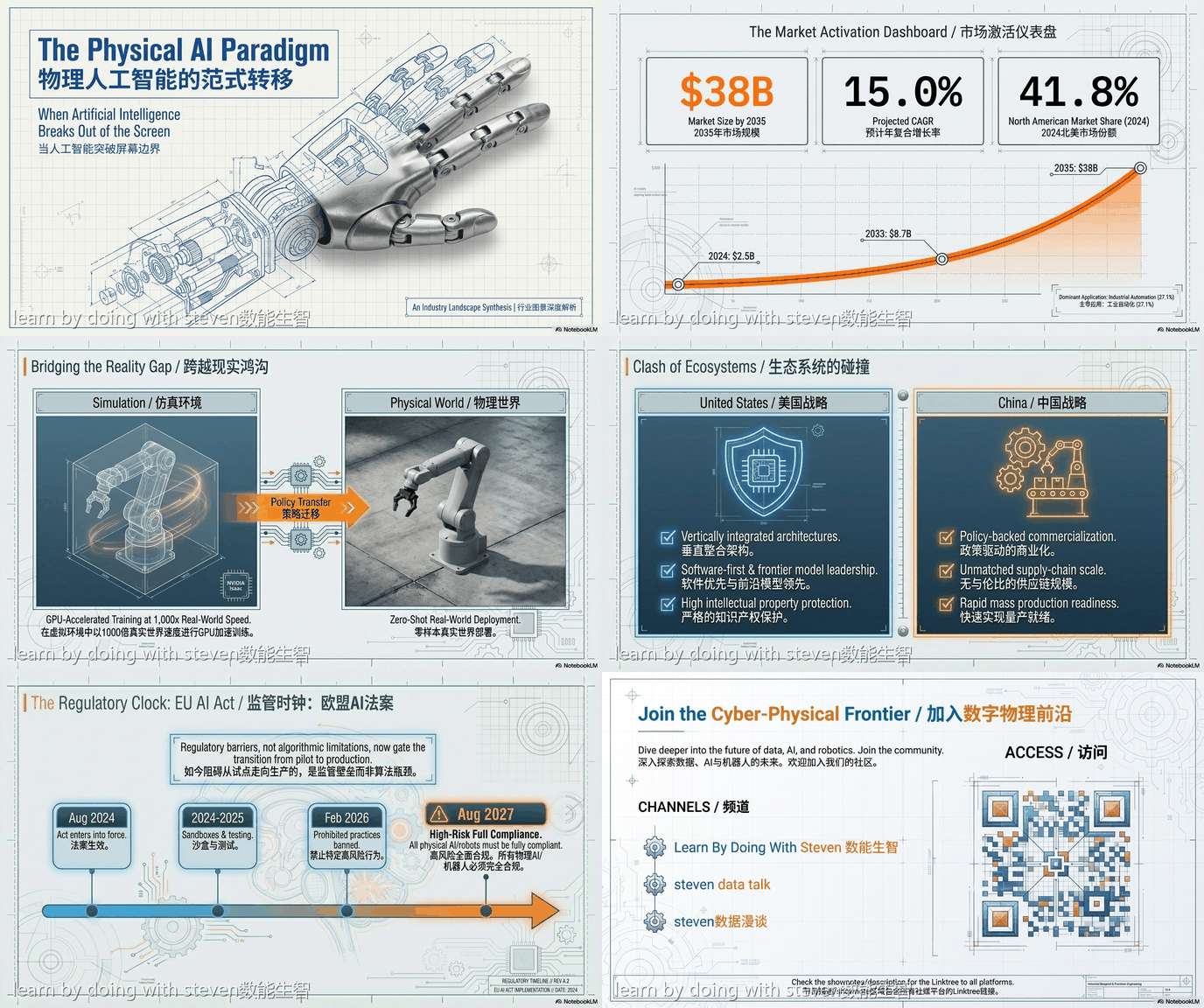
全球具身智能与物理人工智能市场正处于快速增长与系统性变革阶段。相关市场研究预测显示,全球具身智能市场规模预计将从二零二四年的二十五点三三亿美元大幅增长至二零三三年的八十七点五六亿美元,复合年增长率达百分之十五。这一市场扩张主要由制造业、医疗保健、物流仓储和汽车行业对自动化不断增长的需求,以及人工智能与机器人技术的持续进步所驱动。当前,技术演进呈现出模型驱动、软件定义和硬件重构的核心趋势。具身智能大模型与世界模型的深度协同显著提升了机器人的认知与任务泛化能力,而由物理仿真与真实操作构成的虚实融合数据体系正成为机器能力持续进化的关键基础。同时,端侧算力的不断跃升、多模态感知系统的全面升级,以及机器人操作系统向高可靠分布式架构的演进,共同为大规模与高并发的实际工业部署提供了底层支撑。
The global market for embodied artificial intelligence and physical artificial intelligence is currently experiencing a phase of rapid growth and systemic transformation. Relevant market research projections indicate that the global embodied artificial intelligence market size is expected to grow substantially from 2.533 billion US dollars in 2024 to 8.756 billion US dollars by 2033, representing a compound annual growth rate of 15 percent. This market expansion is primarily driven by the increasing demand for automation across the manufacturing, healthcare, logistics warehousing, and automotive sectors, alongside continuous advancements in artificial intelligence and robotics. Currently, technological evolution exhibits core trends of being model-driven, software-defined, and hardware-reconstructed. The deep synergy between embodied artificial intelligence large models and world models has significantly enhanced the cognitive and task generalization capabilities of robots, while a data system blending physical simulation and real-world operations serves as the crucial foundation for the continuous evolution of machine capabilities. Simultaneously, the constant surge in edge computing power, the comprehensive upgrade of multimodal perception systems, and the evolution of robotic operating systems toward highly reliable distributed architectures collectively provide the underlying support for large-scale and highly concurrent practical industrial deployments.
在产业竞争格局与硬件平台发展方面,中美两国企业构成了推动全球具身智能商业化的核心力量,但双方在发展战略上呈现出明显的差异。美国企业普遍倾向于采用垂直整合模式,自主研发执行器、控制系统和人工智能堆栈,优先考量系统的极致性能、安全可靠性以及知识产权保护,并通过分阶段的试点部署稳步推进商业化进程。相比之下,中国企业则更侧重于敏捷迭代与成本效率,通过高度内化的核心零部件制造体系以及开放的研发生态,加速实现规模化量产与早期市场渗透。目前,市场上已涌现出多款处于商业试点或内部验证阶段的先进人形机器人平台。这些平台在全身运动控制、多自由度协调以及微毫米级精细力控方面取得了突破性进展,并已开始在汽车制造产线处理、物流搬运等真实工业环境中进行全流程的自动化检验。
Regarding the industrial competitive landscape and hardware platform development, enterprises from the United States and China constitute the core forces driving the global commercialization of embodied artificial intelligence, though they exhibit distinct differences in their development strategies. American companies generally lean toward a vertically integrated model, developing actuators, control systems, and artificial intelligence stacks in-house, prioritizing extreme system performance, safety and reliability, and intellectual property protection, while steadily advancing the commercialization process through phased pilot deployments. In contrast, Chinese enterprises focus more on agile iteration and cost efficiency, accelerating large-scale mass production and early market penetration through a highly internalized core component manufacturing system and open research and development ecosystems. Currently, multiple advanced humanoid robot platforms in commercial pilot or internal validation stages have emerged in the market. These platforms have achieved breakthrough progress in whole-body motion control, multi-degree-of-freedom coordination, and millimeter-level precise force control, and have begun full-process automated testing in real industrial environments such as automotive manufacturing line processing and logistics handling.
基础模型的突破是物理人工智能加速脱离实验室并走向实际应用的关键动力。视觉语言动作模型的出现,使得机器人能够直接通过自然语言指令,跨越不同形态与场景完成复杂的物理干预任务。当前,双系统控制架构逐渐成为行业标准,即结合负责复杂环境语义理解和长序列任务规划的高层视觉语言认知系统,以及负责高频实时电机控制的底层动作生成系统。为了克服真实世界中机器人数据采集成本高昂且效率低下的瓶颈,研究机构与企业构建了异构数据金字塔,广泛整合了人类第一人称视频、神经生成轨迹和海量物理仿真轨迹。结合潜在动作空间映射和逆动力学模型,这一方法有效扩充了训练语料库。此外,跨机器人形态的大规模标准化数据集进一步促进了策略的迁移学习,使机器人在面对未曾接触过的任务和物体时,展现出更为稳健的泛化适应能力。
Breakthroughs in foundation models constitute the key driving force behind physical artificial intelligence accelerating out of laboratories and into practical applications. The emergence of vision-language-action models has enabled robots to complete complex physical intervention tasks across different forms and scenarios directly through natural language instructions. Currently, a dual-system control architecture is gradually becoming the industry standard, combining a high-level vision-language cognitive system responsible for complex environmental semantic understanding and long-sequence task planning with a low-level action generation system responsible for high-frequency, real-time motor control. To overcome the bottlenecks of high costs and low efficiency associated with robot data collection in the real world, research institutions and enterprises have constructed heterogeneous data pyramids, extensively integrating human first-person videos, neural-generated trajectories, and massive physical simulation trajectories. Combined with latent action space mapping and inverse dynamics models, this approach has effectively expanded the training corpus. Furthermore, large-scale standardized datasets across varying robot morphologies have further facilitated the transfer learning of policies, allowing robots to demonstrate more robust generalized adaptability when facing tasks and objects they have never encountered before.
数字孪生与高保真仿真技术在具身智能的工程化落地与车间级部署中发挥着不可或缺的作用。借助基于图形处理器加速的物理仿真引擎,开发者能够在虚拟数字空间中以超越现实成百上千倍的速度对机器人控制策略进行训练、测试与迭代,从而大幅缩短从概念设计到实际部署的研发周期。物理人工智能的商业化应用正从孤立的测试环境向多元化的真实场景扩展。在制造业中,具身智能机器人能够灵活适应高混合、小批量的现代柔性生产需求;在物流领域,它们实现了从订单拣选到货物码垛的全流程无人化作业;在医疗保健与高危作业环境中,机器人则通过承担繁重或危险的物理劳动来缓解劳动力短缺并降低人员安全风险。随着产业链的逐步成熟和机器人即服务商业模式的兴起,硬件制造成本正稳步下降,企业的评估焦点已全面转向系统的现场可用性、软硬件交付效率以及长期的投资回报率。
Digital twins and high-fidelity simulation technologies play an indispensable role in the engineering realization and shop-floor deployment of embodied artificial intelligence. Utilizing graphics processing unit-accelerated physical simulation engines, developers can train, test, and iterate robotic control policies in virtual digital spaces at hundreds or thousands of times real-world speeds, thereby drastically shortening the research and development cycle from conceptual design to actual deployment. The commercial application of physical artificial intelligence is expanding from isolated testing environments to diversified real-world scenarios. In the manufacturing sector, embodied artificial intelligence robots can flexibly adapt to the modern flexible production demands of high-mix, low-volume manufacturing; in the logistics field, they have achieved fully unmanned operations from order picking to cargo palletizing; in healthcare and hazardous operational environments, robots alleviate labor shortages and reduce personnel safety risks by undertaking strenuous or dangerous physical labor. As the industry chain gradually matures and the Robot as a Service business model rises, hardware manufacturing costs are steadily decreasing, and enterprise evaluation focuses have comprehensively shifted toward on-site system usability, hardware-software delivery efficiency, and long-term return on investment.
尽管具身智能技术展现出巨大的经济潜力与社会价值,其在物理世界中的实体化特征也引入了前所未有的多维度风险与治理挑战。这些潜在风险包括因系统故障、传感器失效或恶意操控而导致的直接物理伤害;机器人全天候运作与未经授权的数据采集所引发的严重隐私泄露;由于大规模自动化升级而带来的劳动力市场冲击与社会经济不平等加剧;以及人类在长期互动中对机器人产生不健康的情感依赖。现有的工业机器人安全标准与自动驾驶监管框架,尚不足以全面覆盖和应对高度自主且具备持续学习能力的具身智能系统。为此,学术界、行业领袖与政策制定机构正呼吁加强针对物理人工智能的安全验证研究,建立强制性的软硬件测试与合规认证体系,明确自主系统在复杂物理交互中的法律责任归属,并前瞻性地规划劳动力技能重塑的社会保障政策,以确保这一变革性技术在安全、透明、可信且符合人类长远利益的轨道上稳健发展。
Although embodied artificial intelligence technology demonstrates tremendous economic potential and social value, its physical embodiment in the real world also introduces unprecedented multidimensional risks and governance challenges. These potential risks include direct physical harm resulting from system malfunctions, sensor failures, or malicious manipulation; severe privacy breaches triggered by round-the-clock robot operations and unauthorized data collection; labor market shocks and exacerbated socioeconomic inequality brought about by large-scale automation upgrades; and unhealthy emotional dependencies developed by humans during long-term interactions with robots. Existing safety standards for industrial robots and regulatory frameworks for autonomous driving are insufficient to comprehensively cover and address highly autonomous embodied artificial intelligence systems capable of continuous learning. Consequently, academia, industry leaders, and policymaking institutions are calling for strengthened safety validation research specific to physical artificial intelligence, the establishment of mandatory software and hardware testing and compliance certification systems, the clarification of legal liability attribution for autonomous systems in complex physical interactions, and proactive planning of social security policies for workforce reskilling, ensuring that this transformative technology develops robustly on a trajectory that is safe, transparent, trustworthy, and aligned with the long-term interests of humanity.
感谢您的阅读。如果您对具身智能、数据科学以及更多前沿科技的实践与探索感兴趣,欢迎关注Learn By Doing With Steven 数能生智以及 steven data talk(steven数据漫谈)等系列节目。相关内容已同步更新在小红书、微信公众号、YouTube、Spotify以及YouTube Music等多个平台。更多详情与完整社媒平台链接,请访问节目描述或shownote区域中的Linktree网址:https://linktr.ee/learnbydoingwithsteven
Thank you for reading. If you are interested in the practice and exploration of embodied artificial intelligence, data science, and more frontier technologies, please check out the “Learn By Doing With Steven” YouTube channel and other platforms, as well as the “steven data talk” podcast on YouTube Music, Spotify, and various other platforms. Related content is available on Xiaohongshu, WeChat Official Accounts, YouTube, Spotify, and more. For further details and a complete list of my social media links, please visit the Linktree URL located in the program description or shownote area: https://linktr.ee/learnbydoingwithsteven
ref: https://36kr.com https://dimensionmarketresearch.com/report/embodied-ai-market https://arxiv.org https://www.meta-intelligence.tech https://www.preprints.org https://www.fujitsu.com https://www.idc.com
#具身智能 #物理人工智能 #人形机器人 #技术趋势 #人工智能 #EmbodiedAI #PhysicalAI #HumanoidRobots #TechTrends #ArtificialIntelligence


